publications
2025
-
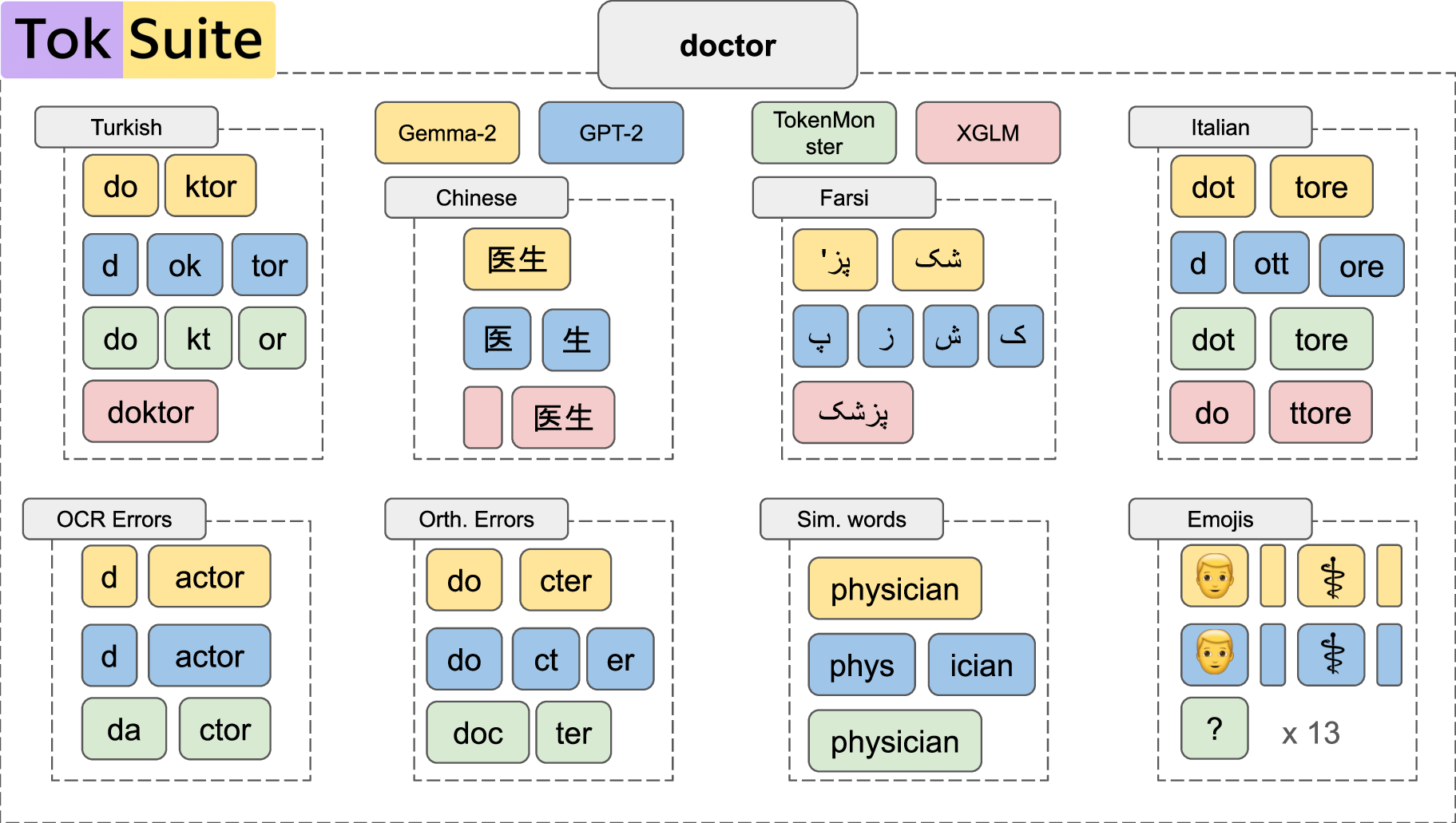 TokSuite: Measuring the Impact of Tokenizer Choice on Language Model BehaviorGül Sena Altıntaş, Malikeh Ehghaghi, Brian Lester, and 4 more authors2025
Tokenizers provide the fundamental basis through which text is represented and processed by language models (LMs). Despite the importance of tokenization, its role in LM performance and behavior is poorly understood due to the challenge of measuring the impact of tokenization in isolation. To address this need, we present TokSuite, a collection of models and a benchmark that supports research into tokenization’s influence on LMs. Specifically, we train fourteen models that use different tokenizers but are otherwise identical using the same architecture, dataset, training budget, and initialization. Additionally, we curate and release a new benchmark that specifically measures model performance subject to real-world perturbations that are likely to influence tokenization. Together, TokSuite allows robust decoupling of the influence of a model’s tokenizer, supporting a series of novel findings that elucidate the respective benefits and shortcomings of a wide range of popular tokenizers.
@misc{altintas2025toksuite, title = {TokSuite: Measuring the Impact of Tokenizer Choice on Language Model Behavior}, author = {Alt{\i}nta{\c{s}}, G{\"u}l Sena and Ehghaghi, Malikeh and Lester, Brian and Liu, Fengyuan and Zhao, Wanru and Ciccone, Marco and Raffel, Colin}, year = {2025}, eprint = {2512.20757}, archiveprefix = {arXiv}, primaryclass = {cs.CL}, url = {https://arxiv.org/abs/2512.20757}, } -
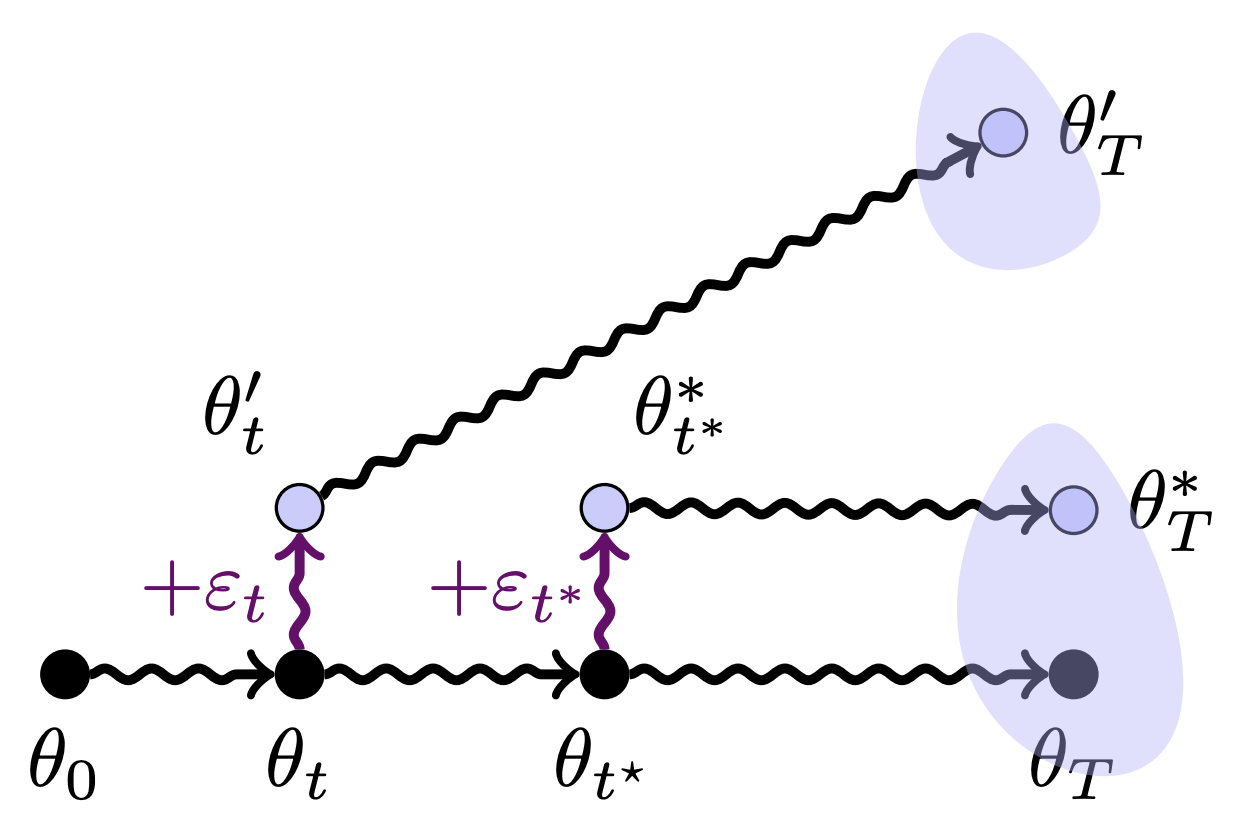 The Butterfly Effect: Neural Network Training Trajectories Are Highly Sensitive to Initial ConditionsGül Sena Altıntaş, Devin Kwok, Colin Raffel, and 1 more authorIn Forty-second International Conference on Machine Learning, 2025
Neural network training is inherently sensitive to initialization and the randomness induced by stochastic gradient descent. However, it is unclear to what extent such effects lead to meaningfully different networks, either in terms of the models’ weights or the underlying functions that were learned. In this work, we show that during the initial “chaotic” phase of training, even extremely small perturbations reliably causes otherwise identical training trajectories to diverge—an effect that diminishes rapidly over training time. We quantify this divergence through (i) L^2 distance between parameters, (ii) the loss barrier when interpolating between networks, (iii) L^2 and barrier between parameters after permutation alignment, and (iv) representational similarity between intermediate activations; revealing how perturbations across different hyperparameter or fine-tuning settings drive training trajectories toward distinct loss minima. Our findings provide insights into neural network training stability, with practical implications for fine-tuning, model merging, and diversity of model ensembles.
@inproceedings{altintas2025butterfly,
  title = {The Butterfly Effect: Neural Network Training Trajectories Are Highly Sensitive to Initial Conditions},
  author = {Alt{\i}nta{\c{s}}, G{\"u}l Sena and Kwok, Devin and Raffel, Colin and Rolnick, David},
  booktitle = {Forty-second International Conference on Machine Learning},
  year = {2025},
  url = {https://openreview.net/forum?id=L1Bm396P0X},
  open_review = {https://openreview.net/forum?id=L1Bm396P0X},
}
2024
-
 The Butterfly Effect: Tiny Perturbations Cause Neural Network Training to DivergeGül Sena Altıntaş, Devin Kwok, and David RolnickIn High-dimensional Learning Dynamics 2024: The Emergence of Structure and Reasoning, 2024
Neural network training begins with a chaotic phase in which the network is sensitive to small perturbations, such as those caused by stochastic gradient descent (SGD). This sensitivity can cause identically initialized networks to diverge both in parameter space and functional similarity. However, the exact degree to which networks are sensitive to perturbation, and the sensitivity of networks as they transition out of the chaotic phase, is unclear. To address this uncertainty, we apply a controlled perturbation at a single point in training time and measure its effect on otherwise identical training trajectories. We find that both the Ł^2 distance and the loss barrier (increase in loss on the linear path between two networks) for networks trained in this manner increase with perturbation magnitude and how early the perturbation occurs. Finally, we propose a conjecture relating the sensitivity of a network to how easily it is permuted with respect to another network.
@inproceedings{altintasButterflyEffectTiny2024,
  title = {The {{Butterfly Effect}}: {{Tiny Perturbations Cause Neural Network Training}} to {{Diverge}}},
  shorttitle = {The {{Butterfly Effect}}},
  author = {Alt{\i}nta{\c s}, G{\"u}l Sena and Kwok, Devin and Rolnick, David},
  year = {2024},
  date = {2024-06-16},
  link = {https://openreview.net/forum?id=T1urv73edU&referrer=%5BAuthor%20Console%5D(%2Fgroup%3Fid%3DICML.cc%2F2024%2FWorkshop%2FHiLD%2FAuthors%23your-submissions)},
  urldate = {2024-10-05},
  eventtitle = {High-Dimensional {{Learning Dynamics}} 2024: {{The Emergence}} of {{Structure}} and {{Reasoning}}},
  langid = {english},
  booktitle = {High-dimensional Learning Dynamics 2024: The Emergence of Structure and Reasoning},
  open_review = {https://openreview.net/forum?id=T1urv73edU}
}
2023
-
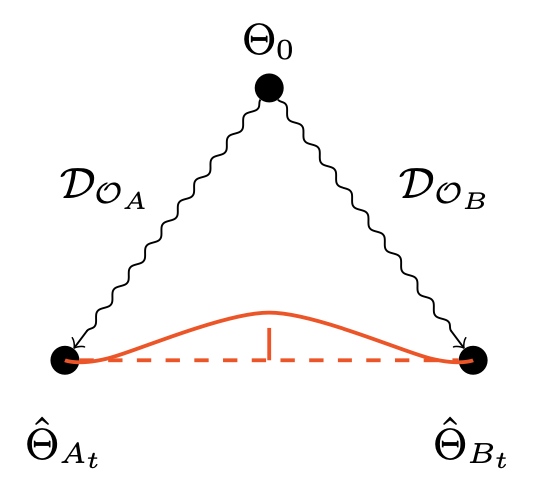 Disentangling Linear Mode ConnectivityGül Sena Altıntaş, Gregor Bachmann, Lorenzo Noci, and 1 more authorIn UniReps: Unifying Representations in Neural Models at Neurips 2023, Oct 2023
Linear mode-connectivity (LMC) (or lack thereof) is one of the intriguing characteristics of neural network loss landscapes. While empirically well established, it unfortunately still lacks a proper theoretical understanding. Even worse, although empirical data points are abound, a systematic study of when networks exhibit LMC is largely missing in the literature. In this work we aim to close this gap. We explore how LMC is affected by three factors: (1) architecture (sparsity, weight-sharing), (2) training strategy (optimization setup) as well as (3) the underlying dataset. We place particular emphasis on minimal but non-trivial settings, removing as much unnecessary complexity as possible. We believe that our insights can guide future theoretical works on uncovering the inner workings of LMC.
@inproceedings{altintasDisentanglingLinearMode2023,
  author = {Alt{\i}nta{\c s}, G{\"u}l Sena and Bachmann, Gregor and Noci, Lorenzo and Hofmann, Thomas},
  langid = {english},
  month = oct,
  title = {Disentangling {{Linear Mode Connectivity}}},
  url = {https://neurips.cc/virtual/2023/80398},
  year = {2023},
  open_review = {https://openreview.net/forum?id=2312.09832},
  booktitle = {UniReps: Unifying Representations in Neural Models at Neurips 2023}
}